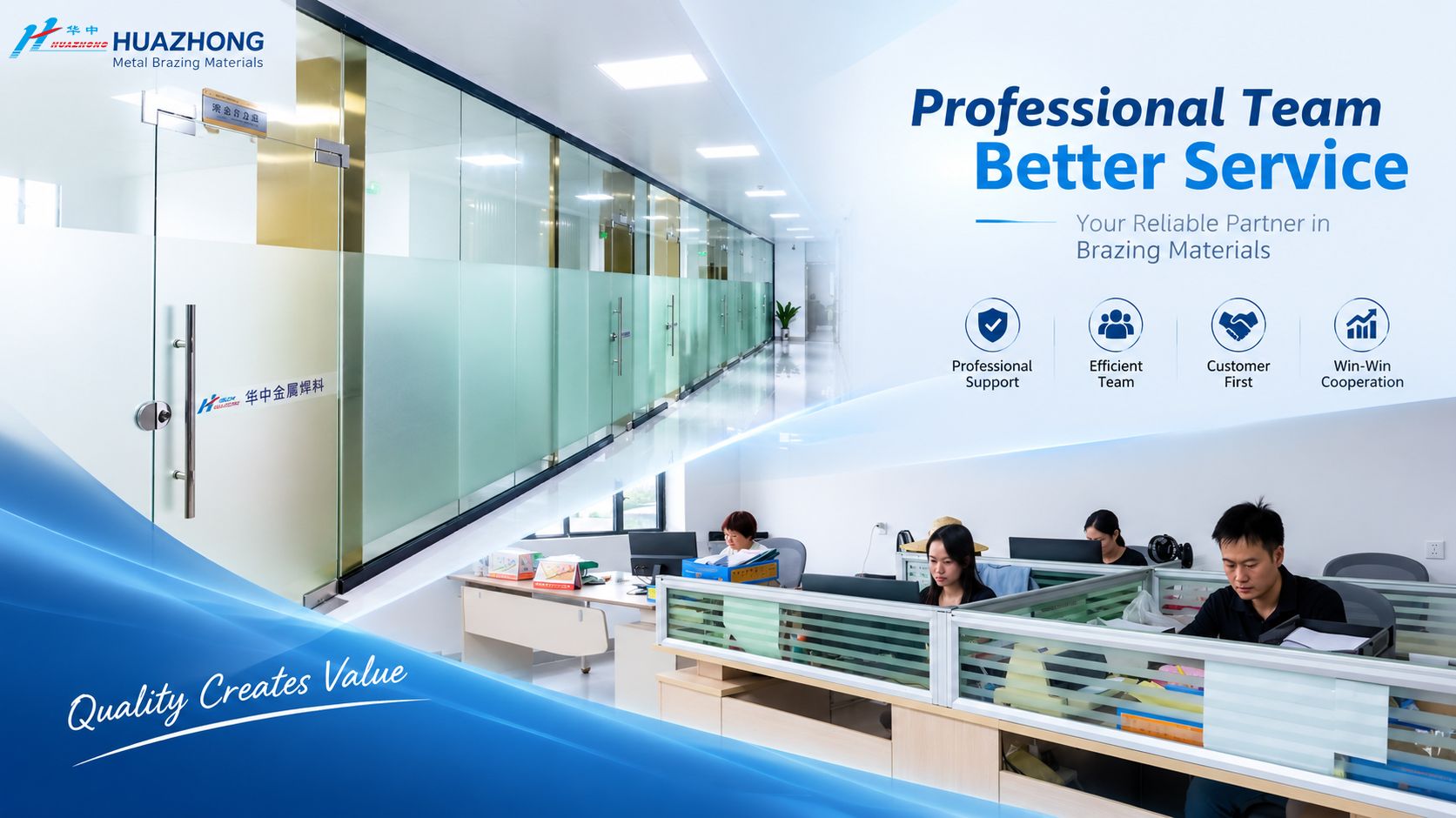

About Us

Huazhong Metal Brazing Materials Co., Ltd is a professional manufacturer of brazing materials, a member of China brazing Academic Society and National Brazing Standard Technologies Committee.The company occupies a territory of more than 10000㎡ and plant premises of 6000㎡, with an annual production capacity of 1500 ton different brazing materials and deoxidant at high quality.
About us
0 + Years

Specializing in Brazing Material

0 Tons/Year

Production Capacity

0 +

Cooperative Business

0 +

Types of Brazing Products


Huazhong Metal Brazing Materials Co., Ltd is a technical oriented company combining all functions of R&D, production, application and technical service. We have very strong technical research abilities; besides of continuous cooperation with various universities and R&D institute in China, we also established long-term partnership with Italy AV Saldature s.r.l. for new products development and application. Our products range includes multiple series: silver alloy, copper alloy, tin alloy, brazing paste and brazing flux; all kinds of alloy can be processed into brazing rods, wires, sheets, rings, powder or even paste, and we can match them with suitable deoxidants. Therefore we are considered as one of the most competitive companies in aspects of factory dimension, products range, brazing technologies and service capabilities.


The company has more than 25 years of successful experiences. Our products was applied in heating exchangers & tubes of refrigerators, air-conditioners, water heaters, and heating elements,transformers, motors, automobile components, bicycles, furniture,  appliances, lamps, stainless steel products. What's more, we export to Europe, America and Southeast Asia.


44a64d8048c0aada58cca1b436df2194.jpg

Why Choose Us

Unmatched Expertise

Unmatched Expertise

Over 25 years of experience as a leading manufacturer of brazing materials, supported by ISO9001 and ISO14001 certifications.

Comprehensive Product Range

Comprehensive Product Range

Silver-based, copper-based, and brazing materials in various forms, including rods, wires, rings, flat wires, spools, and strips.

Global Recognition

Global Recognition

Trusted by 500+ domestic and international clients, with exports to Europe, North America, Southeast Asia, and beyond.

Innovation and Sustainability

Innovation and Sustainability

Cutting-edge R&D partnerships and eco-friendly, RoHS-compliant brazing solutions tailored to modern industrial demands.

Manufactured in our own facilities with quality control spanning from raw materials to finished products, ensuring a stable supply even for large-volume orders.

Cooperative Partner

av
Homa
Midea
HJIC
flower
SEAGULL
anward

Answers to Common Inquiries

Standard products are usually in stock and can be delivered within 3–7 working days. Customized non-standard products generally require 7–15 working days, depending on specifications and order quantity. We support bulk orders, sample trial orders, and global door-to-door delivery, along with technical guidance and after-sales support.

Different brazing pastes are designed for different applications. Universal high-fluidity brazing paste is suitable for torch brazing and manual induction brazing. High-temperature, low-residue paste is ideal for furnace and vacuum brazing, where residue and oxidation must be minimized. High-precision paste is commonly used for screen printing and syringe dispensing. For high-temperature or corrosive equipment, heat-resistant and corrosion-resistant formulas are preferred. For civil and food-contact products, low-residue or food-grade brazing paste is recommended to meet safety and environmental requirements.

Joint cracking and air leakage are common brazing defects, mainly caused by material mismatch, improper temperature, poor surface preparation, and incorrect cooling. 1. Material Mismatch:Different thermal expansion rates between the brazing material and base metal can create residual stress and cause cracks. Low-purity materials may also reduce joint density and lead to leakage. 2. Improper Temperature:Excessive heat can cause grain coarsening and brittle cracking, while insufficient heat prevents complete melting and proper gap filling. 3. Poor Surface Preparation:Oil, oxide layers, dust, and other contaminants can prevent proper bonding, resulting in weak joints and microscopic gaps. 4. Improper Cooling:Rapid cooling can create stress concentration and crack propagation. Controlled slow cooling or heat preservation helps reduce residual stress and improve joint reliability.

Silver-based and copper-based brazing alloys are the two most mainstream brazing materials in the industry, with obvious differences in performance, application scope and cost, which can be selected according to actual working conditions. Silver-based brazing alloys (such as BAg series) feature low melting point, excellent fluidity, strong wettability and high joint strength. They are compatible with multiple base metals including stainless steel, copper, brass and carbon steel, and have good corrosion resistance and ductility. They are widely used in high-precision, high-pressure and vibration-resistant scenarios such as refrigeration, aerospace and automotive parts.

Yes. We provide customized brazing materials and flexible OEM/ODM solutions for different industries. We can adjust the silver content, alloy ratio, melting point, hardness, and corrosion resistance of silver-based, copper-based, aluminum-based, and nickel-based brazing alloys according to customer requirements. Customized forms include brazing rods, wires, strips, and pastes, with options for special packaging and logo printing.

The selection of brazing paste should consider the base metal, brazing process, service environment, and regulatory requirements. Different base metals, such as stainless steel, carbon steel, copper alloys, and tungsten carbide, require compatible paste formulas to ensure good wettability and bonding strength. The paste should also match the process. High-fluidity paste is suitable for torch and manual induction brazing, while furnace and vacuum brazing require high-temperature-resistant, low-residue formulas. For screen printing or syringe dispensing, uniform and precise paste is preferred. Service temperature, corrosion resistance, environmental safety, and food-contact requirements should also be considered.

Copper-based brazing alloys (including copper-phosphorus and copper-zinc brazing materials) have lower cost and stable mechanical properties. Copper-phosphorus brazing materials have self-fluxing effect when welding copper alloys, eliminating the need for additional flux, and are suitable for conventional copper and copper alloy connections. However, they are not applicable to stainless steel and ferrous metal welding, with poor low-temperature toughness and corrosion resistance. They are mostly used for ordinary civil pipeline and low-load mechanical connections. Selection suggestion: Choose silver-based brazing alloys for high precision, harsh working conditions and multi-metal welding; choose copper-based brazing materials for conventional copper alloy welding and cost-sensitive ordinary scenarios.